- Personal
November 7, 2019
Buying a Home: Exploring Your Options

Thinking about buying a place to call home? Then it’s time to think through the home buying process. It can be tempting to start by cruising through your dream neighborhood or checking out house plans, but the most realistic place to start is with the costs.
Benefits of Being a First Time Home Buyer
For many, the journey of buying a home begins as a first-time home buyer. There are several unique benefits of being a first time home buyer that can make this process more accessible and affordable. These can include special loan programs with lower down payment requirements, tax credits, and educational resources designed to guide you through your initial purchase. Keep an eye out for programs specifically designed to assist those entering the housing market for the first time.
Down Payments
The cost of buying a home depends largely on where you live and what you’re buying. No matter your budget, you’ll need to keep certain costs in mind that apply to any purchase. First, you’ll need cash for a down payment, usually a percentage of the total cost of the home. First-time home buyers may be able to put as little as 3-5% down in cash—on a $300,000 home, 3% is $9,000, so that’s still a good chunk of change. Some programs require less of a down payment—ask your lender what is available for you.
Traditionally, buyers are encouraged to put down 20% to avoid paying for private mortgage insurance, or PMI. PMI is a protection for the lender against you defaulting on the loan. If you put down 20% or more, you won’t need mortgage insurance. Otherwise, plan on that additional cost, which could be as much as a few hundred dollars a month on top of your regular mortgage payment.
Mortgage & Fees
Speaking of your mortgage payment, you’ll want to get preapproved for a mortgage so you know what you can afford. Preapproval is not a guarantee that you’ll qualify for a mortgage, but it’s as close as you can get. A lender looks at your income, assets, and credit score, then gives you an idea of the types of loans you qualify for, how much you can borrow, and potential interest rates.
Your mortgage payment depends on the principal amount borrowed, the interest rate for borrowing the money, and the term or length of the mortgage.
Typically, lenders want your mortgage payment (including PMI, property taxes, and homeowners’ insurance) to stay below 28% of your gross monthly income (that’s the amount before taxes are taken out). For example, if your gross pay is $50,000 a year, or roughly $4,100 a month, that gives you a max payment of $1,148 a month. As part of this process, lenders assess your other debts, like car and credit card payments.
Just because you qualify for a specific payment doesn’t mean it’s a wise idea for you. Your mortgage lender has no idea how much you spend on other bills and costs, like groceries, savings, and vacations. It’s up to you to decide how much of a margin you need to keep in your budget to feel financially secure. As a first-time buyer, especially, it may be a good idea to look for a home on the lower end of what you can afford.
When You Don’t Get Approved
Somewhere around 10% of all mortgage loan applications are denied, with a slightly higher rate for Federal Housing Administration (FHA) loan applicants. If you’re turned down for a loan or during the pre-approval process, take the time to find out why. Make sure they are working off of current information—you could have an error on your credit report that is impacting your credit score. If you do find issues on your credit report, contact the credit bureau to report them.
If the denial isn’t because of an error, now is the time to take steps toward securing a mortgage in the future. Keep the following best practices for good credit in mind.
- Build your credit history
- Keep your debt-to-income ratio down
- Make credit payments on time
- Report inaccuracies right away
- Keep accounts open
- Diversify the types of credit accounts
- Minimize new credit lines and inquiries
Under the Fair Housing Law, lenders cannot turn you down because of your age, race, gender, marital status, or religion. If you think you’ve been discriminated against, file a complaint with the U.S. Department of Housing and Urban Development. You can also report the violation to the appropriate government agency provided by the lender, or check with your State Attorney General’s office to see if the creditor violated state laws.
Best Age to Buy a Home
There’s no single answer to the question of the best age to buy a home. It often depends on individual financial readiness, career stability, and personal circumstances. While some may feel ready in their early to mid-twenties, others might find their stride later in their thirties or forties. Factors to consider include having a stable income, manageable debt, and sufficient savings for a down payment and closing costs. The ideal time aligns with your personal and financial goals.
Real Estate Agent Fees
Many homebuyers—especially first-time ones—use a real estate agent to purchase a home. Real estate agents know the market and price trends, know which neighborhoods and features are most desirable, and can help you with price and contract negotiations.
These services come with a cost, though. Real estate agents are typically paid a commission of 5-6% of the purchase price. On a $250,000 property, that’s $12,500 split 50/50 between the buyer’s agent and seller’s agent. Good news though: if you’re buying a home, typically the seller pays the real estate commissions.
Closing Costs
Before a home is truly yours, you’ll need to finalize the sale and sign the documents (many, many documents!). At this time, closing costs are due, too. These are one-time costs that you can either pay upfront or possibly roll into the mortgage. Closing costs cover all of the expenses of applying for the loan and finalizing the sale, and typically run between 2-5% of the overall purchase price. Your closing costs may include fees for services required by your mortgage lender, including:
- Property appraisals
- Title search
- Title insurance
- Origination fee
- Underwriting fee
- Points
Building a Home vs. Buying
Another consideration for prospective homeowners is the choice between building a home vs. buying an existing one. Building allows for complete customization and the opportunity to have a brand-new property built to your exact specifications. However, it can often be a more complex and time-consuming process, with potential for unexpected costs and delays. Buying an existing home typically offers a quicker move-in timeline and established neighborhoods, but may require renovations to meet your preferences.
Buying a Home at a Foreclosure Auction
For some, the path to homeownership involves exploring alternative avenues such as buying a home at a foreclosure auction. This can potentially offer the opportunity to purchase a property at a lower price point. However, it’s crucial to understand the risks involved. Properties at auction are often sold “as-is,” without the opportunity for thorough inspections, and the buying process can be faster and require significant upfront cash.
Buying a Home with Parents
In today’s housing market, particularly for younger individuals, buying a home with parents is becoming an increasingly common strategy. This arrangement can help pool financial resources for a down payment and mortgage, making homeownership more attainable. However, it’s essential to have clear agreements in place regarding ownership, responsibilities, and future plans to ensure a smooth co-ownership experience.
Buying a Home with Owner Financing
Another less traditional route to consider is buying a home with owner financing, also known as seller financing. In this scenario, the seller acts as the lender, providing the mortgage directly to the buyer. This can be an option when traditional financing is difficult to obtain. However, the terms and conditions of owner financing can vary significantly, so it’s crucial to have legal expertise involved to protect your interests.
Renting vs. Buying
The costs associated with buying a home can be overwhelming, but that doesn’t mean it’s the wrong choice. It’s up to you to weigh the benefits of ownership vs. renting.
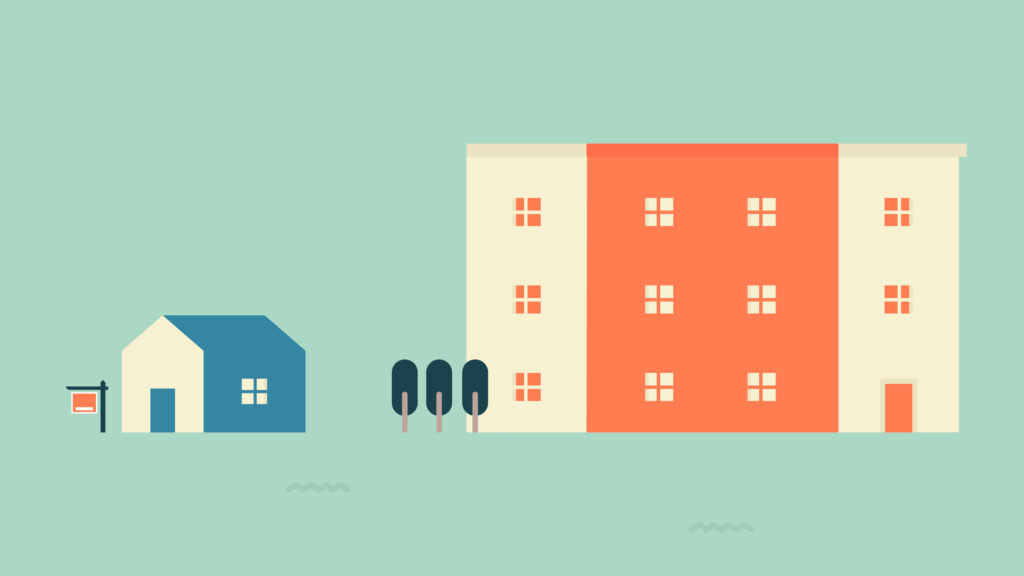
Illustration: Cristi FloresWays Renting Saves You Money
- Don’t pay property taxes
- Don’t pay for maintenance
- Less cash tied up in the property
- No risk of declining property values
- Not tied to a geographic location
Ways Buying a Home Saves You Money
- Deduct mortgage interest and property taxes on your federal tax return
- Build equity as you pay down your mortgage
- Potential profit if home value increases and you decide to sell
- Access to equity through a home equity line of credit (HELOC) if needed for personal loans or other uses
- Feelings of security in owning a home
There is no specific home buying timeline that works for everyone, so make sure you don’t rush the process. Consider the costs, pros, and cons before you make this life-changing decision.
Disclaimer
While we hope you find this content useful, it is only intended to serve as a starting point. Your next step is to speak with a qualified, licensed professional who can provide advice tailored to your individual circumstances. Nothing in this article, nor in any associated resources, should be construed as financial or legal advice. Furthermore, while we have made good faith efforts to ensure that the information presented was correct as of the date the content was prepared, we are unable to guarantee that it remains accurate today.Neither Banzai nor its sponsoring partners make any warranties or representations as to the accuracy, applicability, completeness, or suitability for any particular purpose of the information contained herein. Banzai and its sponsoring partners expressly disclaim any liability arising from the use or misuse of these materials and, by visiting this site, you agree to release Banzai and its sponsoring partners from any such liability. Do not rely upon the information provided in this content when making decisions regarding financial or legal matters without first consulting with a qualified, licensed professional. This article does not offer professional tax advice. Contact a tax advisor for more details.
Posted In: Home
Explore All The Ways We Can Help You Grow
-
 Coach
Coach
What Mortgage Can I Afford?
Find the mortgage that will work best with your goal monthly payment.
Keep Reading About What Mortgage Can I Afford? -
 Article
Find a Place to Rent
Finding the right place to rent requires understanding your budget and needs.
Keep Reading About Find a Place to Rent -
 Article
How to Tap into Your Home’s Equity with Confidence
Learn how to leverage your home equity responsibly with a HELOC or Home Equity Loan.
Keep Reading About How to Tap into Your Home’s Equity with Confidence
