- Personal
- Membership
- Membership
- Rates & Fees
- Checking
- Checking
- Personal Loans
- Personal Loans
- Wealth Management
- Investment Services
- Financial Advisors
- Resource Center
- Business
November 7, 2019
Picking the Right Credit Card for You

Finding the right credit card isn’t as easy as filling out the first application you get in the mail—or at least it shouldn’t be. To use credit to your maximum advantage, it’s best to shop around before picking the right card for your needs.
Questions to Ask Yourself
First, determine why you want or need a credit card and how you plan to use it every month.
- Do you plan to pay off your balances in full and on time every month?
- If not, how many months will you spread repayment over?
- Are you looking to transfer the balance of another credit card?
- Are you primarily interested in maximizing rewards?
- Do you want to use a credit card to build or repair your credit?
- Do you shop primarily at one store?
These answers can help you get the maximum benefit from your credit card at the lowest cost to you.
Types of Credit Cards
Credit cards aren’t one-size-fits-all. There are different categories of credit cards and each one works differently than the rest.
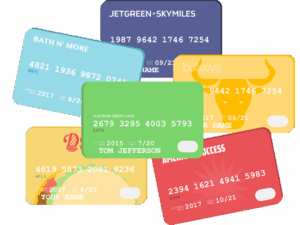 Illustration: Cristi Flores
Traditional Credit Cards
The most basic credit cards are those that operate on one of the four major international networks: Mastercard, Visa, American Express, and Discover.
The network determines where you can use your card—for example, some retailers only accept Visa, while others only accept Mastercard. If you’re loyal to a particular retailer, make sure to pick a credit card network they accept.
The details of how your credit card works, like the interest, fees, and rewards, are up to the card issuer. With an American Express or Discover card, the network is also the issuer. Visa and Mastercards use a separate card issuer, such as a bank or credit union.
No matter the network, all traditional credit cards have a spending limit that is generally determined by your credit history. You can pay your bill in full every month or pay what you owe over time.
If you opt to pay over time, you’ll make at least one minimum payment every month and your balance due accrues interest, which is the cost of borrowing money. If you fail to pay at least the minimum, you’ll likely face a late charge and your credit rating will take a hit, too.
Charge Cards
Sometimes people use the terms “charge card” and “credit card” like they mean the same thing. Although charge cards are a type of credit card, there is a critical difference—you must pay off a charge card balance in full every month. Charge cards don’t include a preset spending limit and most bill an annual fee. They also aren’t available from a wide range of card issuers.
If you don’t pay your charge card in full, it’s possible the issuer will close your card and charge you a fee. Charge cards are generally only available to those with excellent credit.
Secured Cards
Sometimes called credit-builder cards, secured credit cards require a deposit in a savings account or money market account with the issuing bank. The amount you deposit is equal to your card spending limit. For instance, a $500 limit requires a $500 deposit. This is how the card issuer minimizes the risk of giving a credit card to someone with little to no credit.
If you don’t make on-time payments, they’ll withdraw the amount due from your savings account. As you pay on time and your credit rating improves, you should eventually qualify for a traditional credit card.
Cosponsored Cards
It’s common for a financial institution to partner with another company, like an airline or retailer, to issue a cosponsored card under one of the major networks. The card issuer (usually a bank or credit union) handles the billing, while the other brand handles the perks, like travel points for airline trips or cashback at retail stores.
Often, these cards award large reward bonuses when you enroll and meet the bonus requirements. After that, you usually earn rewards on every purchase. You’ll probably need to spend a large amount before reaping any major benefits from the card. These cards often charge annual fees and higher annual percentage rates (APR), which is the yearly cost of using credit.
Why Interest Matters
If you pay your balance in full, a credit card’s annual percentage rate or APR doesn’t really matter. But if you don’t always pay in full or spread payments over time, the interest rate is a main factor in deciding between cards. For instance, some cards offer teaser rates with incredibly low interest—or even no interest—for a specific timeframe, like six months. After that, a higher rate comes into play.
Looking at the APR gives you a true picture of the cost. APR is the yearly interest charged on a borrowed sum, and credit card companies are required to disclose the APR to any borrowers. Comparing APRs is a good apple-to-apple comparison for credit card terms.
Keep in mind that there are variable rates and fixed rates. Just like it sounds, variable rates change more often. Fixed rates are steadier, but these can change too, but you’ll be given at least 45 days’ notice before any rate change goes into effect.
Know Your Terms
- Annual percentage rate (APR): This is the yearly cost of using credit and is used for direct comparison when shopping for the right credit card.
- Finance charge: What you actually pay to use credit. The dollar amount is determined by the amount you borrow, the term, and the APR, and it is applied every month you do not pay your balance off in full.
- Grace period: How many days you have to pay your bill before a finance charge applies.
- Late payment fee: The fee charged if you don’t pay the minimum payment by the due date.
- Minimum payment: The amount you need to pay by the due date. Failure to pay at least this amount will likely result in a late payment fee on the next bill.
- Over limit fee: This fee applies if you charge more than your credit limit. Note that cardholders can’t be charged over limit fees unless they “opt-in.”Because of that, many card issuers no longer charge over-limit fees. Instead, your purchase will be declined or your issuer could cancel your card if you chronically exceed the limit.
Disclaimer
While we hope you find this content useful, it is only intended to serve as a starting point. Your next step is to speak with a qualified, licensed professional who can provide advice tailored to your individual circumstances. Nothing in this article, nor in any associated resources, should be construed as financial or legal advice. Furthermore, while we have made good faith efforts to ensure that the information presented was correct as of the date the content was prepared, we are unable to guarantee that it remains accurate today.Neither Banzai nor its sponsoring partners make any warranties or representations as to the accuracy, applicability, completeness, or suitability for any particular purpose of the information contained herein. Banzai and its sponsoring partners expressly disclaim any liability arising from the use or misuse of these materials and, by visiting this site, you agree to release Banzai and its sponsoring partners from any such liability. Do not rely upon the information provided in this content when making decisions regarding financial or legal matters without first consulting with a qualified, licensed professional.
Posted In: Credit
Explore All The Ways We Can Help You Grow
-
 Article
Debt-to-Income Ratio: A Key Metric for Your Financial Health
If you want to quickly check your financial pulse, your debt-to-income ratio is a key way to do that.
Keep Reading About Debt-to-Income Ratio: A Key Metric for Your Financial Health -
 Article
Suspect Your Information Was Compromised? Here’s What You Can Do
From freezing your credit to reviewing your statements, there are steps you can take if you fear your sensitive information has fallen into the wrong hands.
Keep Reading About Suspect Your Information Was Compromised? Here’s What You Can Do -
 Calculator
Personal Loan Calculator
Estimate monthly payments for a personal loan under different terms.
Keep Reading About Personal Loan Calculator